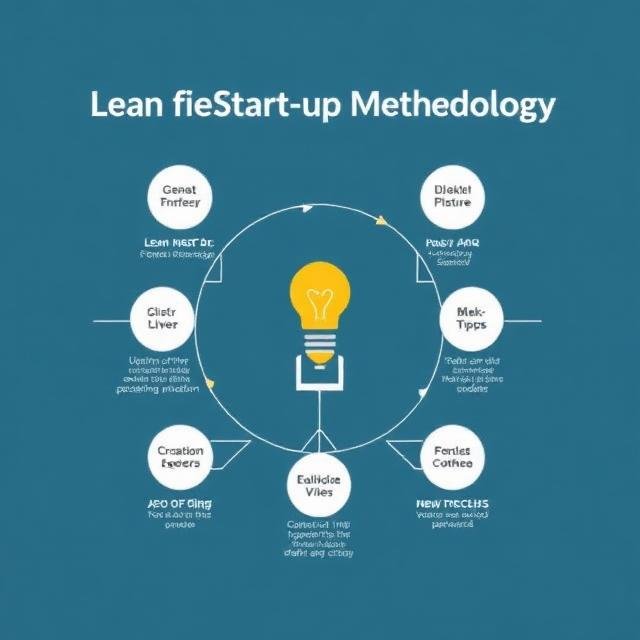
Launching a startup is risky, but the Lean Startup methodology offers a smarter way to build products that customers actually want. Instead of spending months (or years) developing a product in isolation, the Lean Startup approach focuses on rapid experimentation, customer feedback, and continuous improvement.
In this guide, the Lean Startup methodology is explained step by step, making it easy for beginners to understand and apply.
What Is the Lean Startup Methodology?
The Lean Startup methodology is a business approach developed by Eric Ries that emphasizes building startups through validated learning, fast experimentation, and customer-centric development.
Its core goal is simple:
Minimize waste and maximize learning while building a successful business.
Why Use the Lean Startup Approach?
Lean Startup helps entrepreneurs:
- Reduce the risk of failure
- Save time and money
- Validate ideas before scaling
- Adapt quickly to customer needs
- Build sustainable businesses
It’s especially effective for startups operating under uncertainty.
Step 1: Start with a Problem Hypothesis
Every startup begins with assumptions.
Ask yourself:
- What problem am I trying to solve?
- Who experiences this problem?
- Why is it important to them?
These assumptions form your problem hypothesis, which must be tested—not assumed to be true.
Step 2: Define Your Value Proposition
Your value proposition explains why customers should choose your product.
It should clearly state:
- The problem you solve
- Who you solve it for
- How your solution is different or better
A strong value proposition guides all future decisions.
Step 3: Build a Minimum Viable Product (MVP)
An MVP is the simplest version of your product that delivers value and tests your assumptions.
Examples of MVPs:
- Landing pages
- Prototypes or demos
- Manual services
- Basic apps or tools
The goal is learning—not perfection.
Step 4: Launch and Test with Real Users
Once your MVP is ready, put it in front of real customers.
What to test:
- User interest
- Engagement levels
- Willingness to pay
- Feature usage
Real-world data is more valuable than opinions.
Step 5: Measure Key Metrics
Data-driven decisions are central to Lean Startup.
Track actionable metrics such as:
- Customer acquisition cost
- Retention and churn
- Conversion rates
- Revenue growth
Avoid vanity metrics that don’t reflect real progress.
Step 6: Learn from Customer Feedback
Customer feedback provides insight into what works and what doesn’t.
Collect feedback through:
- User interviews
- Surveys
- Behavioral analytics
- Support requests
Look for patterns, not individual opinions.
Step 7: Decide to Pivot or Persevere
Based on your learnings, make a strategic decision.
- Persevere if your assumptions are validated
- Pivot if the data suggests a better direction
Pivoting is not failure—it’s progress through learning.
Step 8: Iterate and Improve
Continuous improvement is at the heart of Lean Startup.
Iterate by:
- Refining features
- Improving user experience
- Adjusting pricing or messaging
Each iteration should be driven by data and feedback.
Step 9: Scale After Validation
Only scale once you’ve proven demand and a repeatable model.
Focus on:
- Growth strategies
- Process automation
- Team expansion
Scaling too early is one of the most common startup mistakes.
Step 10: Repeat the Build–Measure–Learn Cycle
Lean Startup is not a one-time process.
The Build–Measure–Learn loop continues as your business grows, helping you stay adaptable in changing markets.
Final Thoughts
The Lean Startup methodology explained step by step shows how startups can succeed by learning faster and wasting less. Instead of guessing what customers want, you test ideas, measure results, and adapt based on real data.
By following this approach, entrepreneurs can build better products, reduce risk, and increase their chances of long-term success.